Why Comparison at Work Triggers Envy and How It Quietly Shapes Performance


Workplace envy is the quiet discomfort that arises when you compare your progress, recognition, or opportunities to someone else’s and feel that you are falling behind or being overlooked. It is both a thought pattern and an emotional experience, often mixed with self-doubt, frustration, or tension in how you relate to others at work. It does not mean something is wrong with you. It reflects how meaning, value, and fairness are being interpreted in your environment. The Emerge In Time Model helps you approach this process with patience, allowing change to unfold in stages rather than forcing immediate resolution.
Why It Happens
Internal Patterns
Comparison is a natural way your mind tries to measure progress and safety. At work, where feedback can be uneven or unclear, your brain fills in gaps by looking at others as reference points. This can activate concerns about your own competence, belonging, or future direction.
Over time, this turns into a pattern. You may begin to scan for who is ahead, who is recognized, or who is progressing faster. The focus shifts from your own path to tracking others, which can quietly shape your motivation, confidence, and decisions.
External Conditions
Work environments often reinforce comparison without intending to. Promotions, visibility, performance metrics, and informal recognition systems create uneven signals about what is valued and who is succeeding.
Lack of transparency, inconsistent feedback, or limited opportunities can intensify this. When it is unclear how progress happens, comparison becomes a substitute for clarity. It starts to feel like the only way to understand where you stand.
Common Misconceptions
- Envy means I am insecure or unprofessional
Envy is a human response to perceived gaps in value or opportunity. It does not define your character or capability. - If I were confident, I would not feel this
Even confident people experience envy when important needs such as recognition or growth feel uncertain or blocked. - I need to eliminate envy quickly
Trying to rush it away often increases pressure. Understanding what it is pointing to tends to be more useful than forcing it to disappear. - It is about the other person
While it may feel focused on someone else, the experience is usually about how your own progress and value are being interpreted. - If I ignore it, it will go away
Ignoring it can allow the pattern to deepen, especially if the underlying conditions remain unchanged.
Observable Signs
Not all of these show up for everyone, and they can vary in intensity over time:
- Frequent comparison of your progress, recognition, or workload to others
- Subtle frustration or tension when colleagues succeed or are recognized
- Questioning your own value despite objective performance
- Difficulty focusing on your own tasks because attention shifts to others
- Overanalyzing decisions made by leaders or perceived favoritism
- Pulling back from collaboration or, in contrast, overextending to prove worth
- Feeling stuck, even when opportunities are present
- Changes in motivation, such as bursts of urgency followed by disengagement
- Interpreting neutral situations as signs of being overlooked
What Often Helps
- Clarity about your own path
When you define what progress looks like for you, comparison has less control over how you measure yourself. - Consistent, specific feedback
Clear input from managers or peers reduces the need to rely on guesswork through comparison. - Awareness of patterns
Noticing when and why comparison starts can create space between the feeling and your response. - Contextualizing others’ success
Understanding that others have different timelines, roles, or circumstances can reduce the sense of direct competition. - Gradual reframing over time
Through the Emerge In Time Model, you can intentionally move from reacting to comparison toward planning how you want to define progress, rather than inheriting it from your environment.
What Often Worsens It
- Constant exposure to highlight moments
Seeing only visible successes without context can distort how progress is perceived. - Lack of direction or structure
When expectations and growth paths are unclear, comparison fills the gap and becomes more intense. - Internal pressure to catch up quickly
Urgency can turn comparison into stress, making it harder to think clearly about your next steps. - Silence around concerns
Avoiding conversations about growth, recognition, or fairness can reinforce assumptions that may not be accurate. - All-or-nothing thinking
Interpreting situations as either success or failure increases the emotional weight of comparison and limits flexibility in how you respond.
Workplace envy often develops quietly, but it follows understandable patterns. When you begin to see those patterns clearly, it becomes possible to work with them over time rather than react to them in the moment.
Understanding Change Over Time
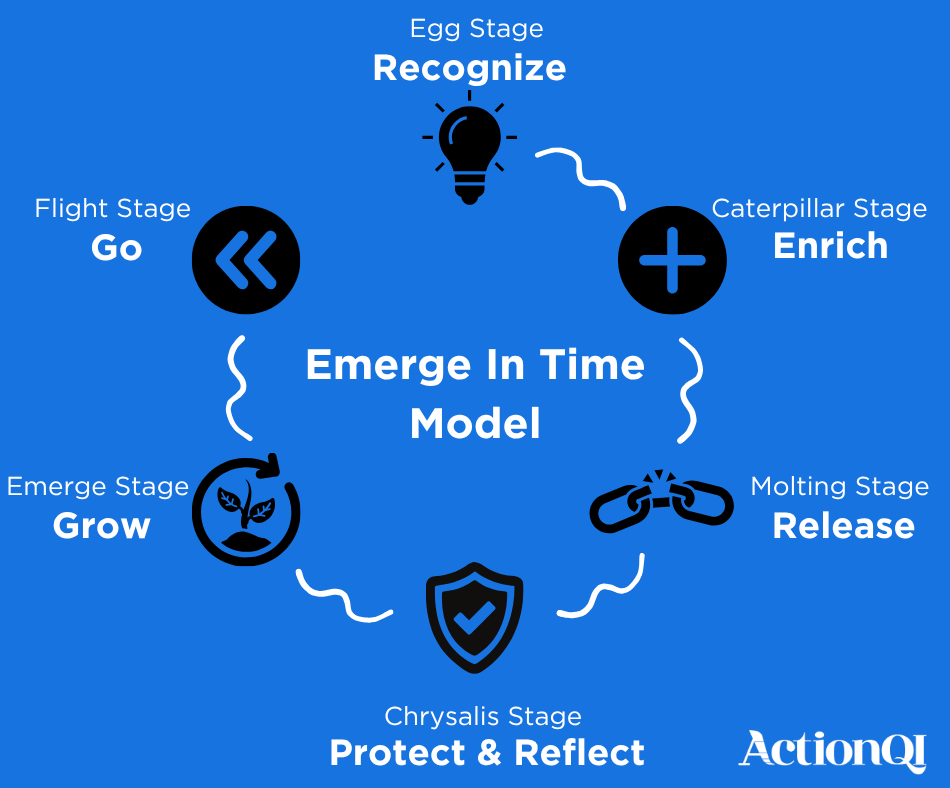
Workplace envy rarely shifts through a single decision. It tends to soften through awareness, small adjustments, and repeated experiences that reshape how you interpret yourself and others. The Emerge In Time Model helps you approach this process with patience, allowing change to unfold in stages rather than forcing immediate resolution.
Recognize – Egg Stage
In this stage, workplace envy becomes more visible. You may notice moments where comparison quickly shifts your mood, such as hearing about a colleague’s promotion or recognition. There can be confusion about why it affects you so strongly, along with a tendency to question your own progress or value. The experience often feels reactive and difficult to control.
Progress here is not about changing the feeling yet. It is about seeing it clearly. You begin to identify patterns, such as when comparison shows up, who it involves, and what thoughts follow. This awareness creates a starting point that was not there before.
Noticing envy is not a setback. It is the first step in understanding what matters to you.
Enrich – Caterpillar Stage
At this stage, you begin to introduce new ways of interpreting your experience. Instead of relying only on comparison, you explore what growth, recognition, or progress means in your own context. This may include seeking clearer feedback, building skills, or learning how others have navigated similar paths.
Workplace envy may still appear, but it is now accompanied by moments of curiosity. You start to ask different questions, such as what you can learn or what is within your influence. The focus begins to expand beyond simply measuring yourself against others.
Progress looks like adding supportive inputs rather than removing envy entirely. You are building a foundation that gives you more options in how you respond.
You do not need to stop comparison to grow. You can begin building alongside it.
Release – Molting Stage
Here, you start to let go of patterns that intensify workplace envy. This might include constant monitoring of others’ progress, assumptions about fairness, or beliefs that your value is defined by external recognition. Letting go can feel uncomfortable because these patterns may have once provided a sense of control or direction.
You may notice moments where you catch yourself mid-comparison and choose not to follow the same line of thinking. This does not happen consistently yet, but the interruption itself is meaningful.
Progress in this stage is uneven. Some days feel lighter, while others return to old habits. What matters is that the pattern is no longer automatic in the same way.
Letting go is not about removing thoughts completely. It is about loosening their influence over time.
Protect and Reflect – Chrysalis Stage
In this stage, you begin to shape your environment and habits more intentionally. You may create boundaries around situations that intensify comparison, such as limiting exposure to constant performance discussions or unhelpful conversations. At the same time, you reflect on what is working and what still feels difficult.
Workplace envy may feel quieter, but also more noticeable in specific situations. This is because you are paying closer attention to its triggers and your responses. Reflection helps you adjust your approach rather than repeat patterns automatically.
Progress looks like stability. You are not just reacting differently, but also creating conditions that support those changes.
Protecting your focus is not avoidance. It is creating space for more intentional growth.
Grow – Emerge Stage
At this point, you begin to experience workplace envy differently. It may still arise, but it carries less urgency and less influence over your decisions. You are more able to stay connected to your own goals, even when others succeed or move ahead.
There is also a growing sense of resilience. Setbacks, such as missed opportunities or slower progress, feel less defining. You start to see them as part of a longer process rather than evidence of falling behind.
Progress in this stage is reflected in how you respond, not in the absence of envy. You recover more quickly and make choices that align with your own direction.
Growth is not measured by never feeling envy. It is measured by how you move forward when it appears.
Go – Flight Stage
In this stage, new patterns become part of your everyday experience. You relate to comparison with more balance, using it as occasional information rather than a constant measure of your worth. Your attention is more consistently directed toward your own path and priorities.
Workplace envy may still surface at times, especially in high-stakes situations, but it no longer shapes your overall sense of progress. Instead, it becomes one signal among many, rather than the dominant one.
Progress here is ongoing. You continue to practice, adjust, and refine how you approach your work and your growth. The changes are sustained through repetition, not perfection.
You are not trying to eliminate envy forever. You are learning how to live and grow without being defined by it.
Understanding workplace envy in a clearer, more grounded way is already a meaningful shift. You may not feel different right away, but being able to recognize patterns, name what is happening, and see where you are in the process creates space that was not there before. Change tends to build through that space, gradually and with repetition, rather than through pressure or quick fixes. If you want to continue exploring this at your own pace, our eWorkbook Overcoming Workplace Jealousy: Thriving Beside Successful Colleagues offers additional ways to work with these patterns over time. You can sign up as a free member to access this workbook and guides whenever you feel ready, using them as support rather than direction.