Beyond Root Cause Analysis: Using ActionQI’s TRACE Framework to Strengthen HAI Investigations

Healthcare-associated infection (HAI) investigations often begin with a straightforward question:
“What caused the infection?”
But in practice, HAIs such as CLABSIs rarely emerge from a single cause. They develop within complex care environments shaped by:
- operational pressures,
- workflow disruptions,
- competing priorities,
- communication breakdowns,
- staffing realities,
- environmental conditions, and
- adaptations made during real-world care delivery.
Traditional investigations sometimes focus too narrowly on policy deviations or individual actions. This can lead organizations to miss the broader system conditions that influenced care reliability and infection risk.
That is why ActionQI developed the TRACE HAI Investigation Framework.
TRACE is a structured investigative and learning model designed to help organizations move beyond blame-focused reviews toward operational understanding, systems thinking, and sustainable improvement.
Rather than asking, “Who failed?”
TRACE helps teams explore:
- what happened,
- what conditions existed,
- how workflows unfolded,
- what risks emerged, and
- what system improvements may reduce future harm.
What Does TRACE Stand For?
Timeline
Reconstruct care events and operational conditions during the infection window.
Risks and Contributing Factors
Identify exposures, vulnerabilities, workflow issues, behaviors, and system conditions associated with infection risk
Analysis
Understand how identified factors influenced infection risk or workflow reliability
Corrective Actions
Identify opportunities to strengthen systems, workflows, and prevention reliability
Enabling Conditions
Identify organizational or operational supports necessary for sustainable improvement
Why Structured Investigation Models Matter
Without structure, investigations often become:
- inconsistent,
- narrative-heavy,
- hindsight-driven, or
- focused only on compliance gaps.
A structured framework helps reviewers:
- organize information consistently,
- identify patterns more reliably,
- uncover latent system vulnerabilities,
- reduce hindsight bias, and
- connect findings directly to improvement opportunities.
Structured models also improve organizational learning over time. When investigations use consistent categories and themes, organizations can begin identifying recurring operational risks across multiple events rather than treating each HAI as an isolated occurrence.
For example, repeated findings involving:
- workflow interruptions,
- float staff unfamiliarity,
- delayed escalation, or
- supply access issues
may indicate broader system reliability concerns requiring organization-level intervention.
Why the Timeline Is the Foundation of the Investigation
One of the most important parts of any HAI investigation is the timeline reconstruction.
The timeline is not simply a list of events. It establishes the framework for understanding:
- how care unfolded,
- what operational conditions existed,
- when risks emerged, and
- how contributing factors interacted over time.
Without a clear timeline, reviewers may unintentionally:
- jump to conclusions,
- over-focus on isolated actions, or
- miss the operational context surrounding care delivery.
A strong timeline helps reviewers identify:
- delays,
- transitions in care,
- interruptions,
- staffing pressures,
- competing priorities,
- device-related events,
- escalation concerns, and
- workflow variability.
Most importantly, the timeline creates the bridge between:
- observable events, and
- the deeper risks and contributing factors uncovered later in the investigation.
When Should TRACE Be Used?
TRACE is most effective for:
- CLABSI investigations
- CAUTI investigations
- Surgical site infection reviews
- Device-associated infection events
- Complex infection prevention reviews
- Events involving multiple operational or workflow contributors
- Trend analysis across recurring HAIs
- Organizational learning reviews
- Multidisciplinary infection prevention investigations
TRACE is especially valuable when organizations want to understand:
- how work was actually performed,
- how operational pressures influenced care, and
- where system reliability may have weakened.
When TRACE May Not Be Necessary
TRACE may not be necessary for:
- straightforward documentation corrections,
- isolated reporting errors,
- events with minimal investigative complexity,
- or situations already fully understood with no operational or workflow concerns identified.
Organizations should avoid overcomplicating simple issues that do not require extensive systems analysis.
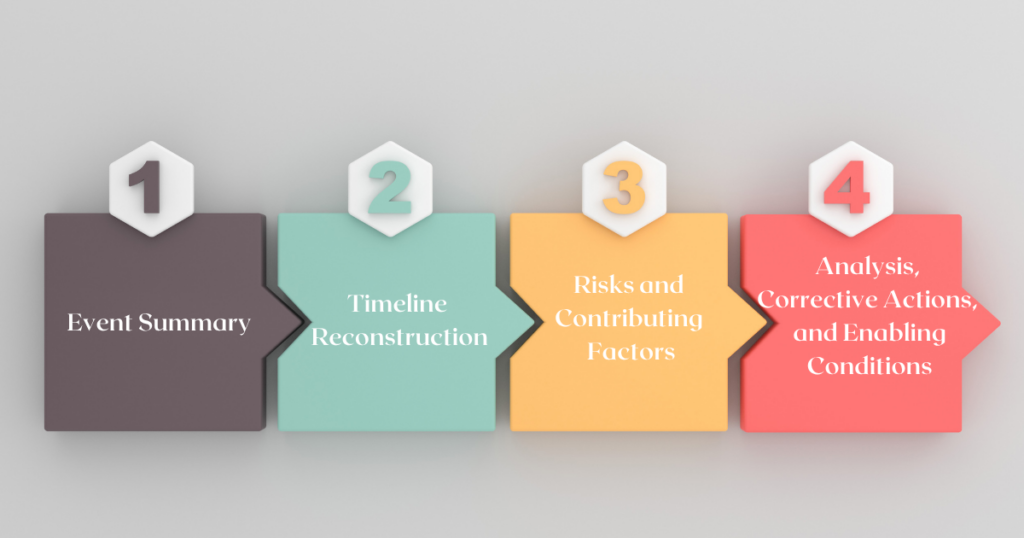
Section 1: Event Summary
Establishing the Clinical and Operational Snapshot
The Event Summary provides reviewers with a concise overview of the event before deeper analysis begins.
This section helps establish:
- the infection under review,
- patient risk factors,
- device-related information, and
- the overall patient impact.
The purpose is not to retell the entire story. Instead, it creates a focused snapshot that anchors the rest of the investigation.
Information commonly collected includes:
- HAI type,
- organism,
- patient demographics,
- presenting diagnosis,
- comorbidities,
- device information,
- admission locations, and
- clinical outcomes.
Example Questions
- What infection is being investigated?
- What patient factors may have increased infection risk?
- What devices were present?
- What units or care settings were involved?
- When was the infection identified?
Tips
- Keep entries concise and factual.
- Focus on clinically relevant information.
- Use objective terminology.
- Document only information relevant to understanding the infection event.
Watch Outs
- Avoid including assumptions about causation.
- Avoid overly detailed narrative summaries.
- Do not interpret findings in this section.
Section 2: Timeline Reconstruction
Understanding How Care Unfolded
The Timeline Reconstruction is the backbone of the TRACE Framework.
This section seeks to uncover:
- the sequence of events,
- operational conditions during care delivery,
- and how risks emerged over time.
Reviewers should reconstruct the infection window chronologically, documenting both clinical events and surrounding operational context.
Important timeline elements may include:
- line insertions,
- dressing changes,
- medication administration,
- patient transfers,
- staffing conditions,
- environmental concerns,
- workflow interruptions,
- escalation events, and
- changes in patient condition.
The timeline should reflect not only what happened, but the conditions under which care occurred.
Example Questions
- What was happening on the unit at the time?
- Were there staffing shortages or high census conditions?
- Did any delays, interruptions, or transitions occur?
- When was the line inserted, accessed, or reassessed?
- Were there emergency situations or competing priorities?
Tips
- Build the timeline before conducting deep analysis.
- Use timestamps whenever possible.
- Include operational context, not just clinical events.
- Gather information from multiple sources:
- chart review,
- staff interviews,
- environmental observations,
- and workflow review.
Watch Outs
- Avoid jumping ahead to conclusions.
- Do not use the timeline to assign blame.
- Avoid reconstructing events solely from hindsight.
- Be cautious of missing contextual factors such as staffing or workload pressures.
Section 3: Risks and Contributing Factors
Looking Beyond Individual Actions
This section explores the conditions, behaviors, perceptions, and operational realities associated with infection risk. TRACE intentionally separates this phase from the timeline because identifying risks requires deeper exploration beyond simply documenting events.
Reviewers examine:
- workflow vulnerabilities,
- operational pressures,
- system conditions,
- knowledge gaps,
- beliefs,
- attitudes,
- and actual care practices.
The framework uses a structured KABP approach:
- Knowledge,
- Attitudes,
- Beliefs,
- and Practices,
alongside broader System Factors.
This helps reviewers understand not just what staff were expected to do, but:
- how work was understood,
- how work was actually performed,
- and what conditions influenced care delivery.
Example Questions
System Factors
- Were there operational pressures affecting care?
- Did staffing or workflow conditions influence reliability?
- Were interruptions common?
Knowledge
- Did staff understand the expected process?
- Were policies or workflows unclear?
- Was onboarding sufficient?
Attitudes
- How did staff feel about the workflow or documentation burden?
- Did staff feel supported during high workload periods?
Beliefs
- What did staff believe contributed to infection risk?
- Were there perceptions that some practices were less important?
Practices
- How was care actually performed?
- Were workarounds or adaptations used?
- Did workflows vary between staff?
Tips
- Use interviews as opportunities to learn, not interrogate.
- Focus on understanding workflow realities.
- Document specific examples and observations.
- Explore both human and system influences.
Watch Outs
- Avoid framing questions in a punitive way.
- Do not confuse policy expectations with actual practice.
- Avoid oversimplifying findings into “noncompliance.”
- Be cautious of hindsight bias when interpreting behaviors.
Section 4: Analysis, Corrective Actions, and Enabling Conditions
Turning Findings Into Sustainable Improvement
This section connects investigation findings to meaningful improvement opportunities.
The goal is to analyze:
- how identified factors increased infection risk,
- where reliability weakened,
- and what system changes may reduce future harm.
TRACE separates:
- Corrective Actions,
from - Enabling Conditions.
This distinction is important. Many improvement efforts fail not because the idea was wrong, but because the operational conditions required for success were never addressed.
For example:
- a corrective action may involve protected workflow periods during line access,
- while the enabling condition may require staffing support during peak census periods.
This helps organizations think beyond surface-level recommendations.
Example Questions
- How did this factor influence infection risk?
- What system vulnerability does this reveal?
- What workflow or operational changes may improve reliability?
- What conditions are necessary for successful implementation?
- What barriers may prevent sustainability?
Tips
- Link corrective actions directly to identified findings.
- Focus on strengthening systems and workflows.
- Prioritize sustainable improvements over temporary fixes.
- Consider operational feasibility during recommendation development.
Watch Outs
- Avoid recommendations based solely on re-education.
- Avoid vague actions such as “staff should be more careful.”
- Do not ignore staffing, workflow, or operational realities.
- Avoid improvement plans that rely entirely on memory or vigilance.
TRACE Is Designed for Learning, Not Blame
One of the greatest strengths of the TRACE Framework is its focus on operational understanding and organizational learning.
Healthcare workers often deliver care under:
- time pressure,
- competing demands,
- interruptions,
- staffing challenges, and
- changing patient conditions.
TRACE helps organizations examine those realities directly.
By understanding:
- how work unfolded,
- what conditions influenced care, and
- where reliability weakened,
organizations can move beyond isolated corrective actions toward stronger, more resilient infection prevention systems.
The goal is not simply to complete an investigation. The goal is to build safer systems of care.