Why Leading Without Being the Expert Feels So Uncomfortable and What Leadership Actually Requires


Leadership confidence is the ability to guide people, make decisions, and hold responsibility even when you do not have all the answers or technical expertise yourself. It often feels uncomfortable because leadership shifts your role from knowing to navigating, from solving problems directly to helping others move through uncertainty together. Confidence in leadership is less about certainty and more about learning to stand steadily while outcomes are still unclear. The Emerge In Time Model helps you understand this change as a gradual process, allowing space for practice, patience, and self-compassion while new ways of leading take shape.
Why It Happens
The Internal Experience: Identity, Responsibility, and Uncertainty
Many people develop confidence through mastery. Earlier in your career or life, confidence likely came from being capable, knowledgeable, or reliable in doing the work yourself. Leadership changes that foundation. Instead of proving competence through expertise, you are asked to create direction, ask questions, and support decisions that depend on other people’s knowledge.
This creates internal tension. Your brain looks for familiar evidence of competence, but leadership provides fewer immediate signals that you are doing well. You may feel exposed, hesitant, or unsure because the feedback loops are slower and less concrete.
Common internal contributors include:
- A learned belief that authority must come from expertise
- Fear of making decisions that affect others
- Discomfort tolerating ambiguity or incomplete information
- A shift from individual achievement to shared responsibility
These reactions are not signs of weakness. They are natural responses to a role that requires a different type of confidence.
The External Environment: Expectations and Systems
Leadership confidence is also shaped by context. Many workplaces unintentionally reinforce the idea that leaders must be the smartest person in the room. Promotions often happen because someone excelled technically, not because they were prepared to lead relationally or strategically.
External contributors may include:
- Organizational cultures that reward certainty over curiosity
- Teams expecting immediate answers rather than collaborative thinking
- Limited training on how leadership actually works
- Systems where mistakes feel highly visible or risky
When internal expectations meet external pressure, discomfort increases. The experience begins to make sense once you recognize that leadership asks for skills rarely taught explicitly.
Common Misconceptions
Good leaders always know the answers.
Leadership is not expertise ownership. Effective leaders create clarity, ask better questions, and help the right expertise emerge from the team. Feeling unsure means you are not ready to lead.
Uncertainty is often evidence that you understand the weight of responsibility. Awareness tends to increase before confidence catches up. Confidence should come quickly after promotion or new responsibility.
Leadership confidence develops through repeated exposure to uncertainty, reflection, and adjustment over time. Asking for input weakens authority.
In practice, thoughtful collaboration often strengthens trust because people feel seen and included in decision-making. Leadership confidence is a personality trait.
Confidence in leadership is largely learned through experience, intentional practice, and reframing what leadership requires.
Observable Signs
Not all signs appear in all people. Experiences vary depending on personality, environment, and stage of leadership development.
- Hesitating to make decisions without complete information
- Overpreparing or over researching before conversations or meetings
- Deferring to experts even when guidance is needed from you
- Feeling pressure to appear certain or composed at all times
- Avoiding difficult conversations out of fear of saying the wrong thing
- Second-guessing decisions after they are made
- Seeking constant validation that you are doing the role correctly
- Working longer hours to compensate for perceived gaps in expertise
- Feeling more mentally tired from people decisions than technical tasks
- Quietly wondering whether others expect more certainty than you can provide
These signs reflect adjustment, not inadequacy.
What Helps vs. What Worsens It
What Often Helps
- Redefining confidence as steadiness rather than certainty
When confidence shifts from knowing everything to navigating responsibly, pressure begins to decrease. - Learning to ask structured questions
Questions allow expertise to surface while keeping leadership direction intact. - Gradual exposure to decision-making
Confidence strengthens when decisions are made, reflected on, and integrated over time rather than avoided. - Supportive peer or mentor relationships
Seeing how other leaders manage uncertainty normalizes the experience. - Clarity about role expectations
Understanding that leadership involves coordination, alignment, and judgment reduces the urge to become the technical expert again. - Time for reflection
Confidence grows when experiences are processed, not just endured.
What Often Worsens It
- Equating leadership with flawless performance
Perfection expectations increase hesitation and self-monitoring. - Constant comparison to highly experienced leaders
Comparing early-stage leadership to mature leadership creates unrealistic internal standards. - Environments that punish uncertainty
When curiosity or learning feels unsafe, people may hide uncertainty rather than grow through it. - Rushing development
Trying to force confidence before understanding the role often leads to burnout or avoidance. - Returning exclusively to technical work for reassurance
While comforting short term, this can delay learning the relational and strategic aspects leadership requires.
Leadership confidence develops through intentional growth over time. Discomfort is often a signal that you are moving from expertise-based identity toward leadership-based capability, a transition that unfolds gradually rather than all at once.
Understanding Leadership Confidence as a Process Over Time
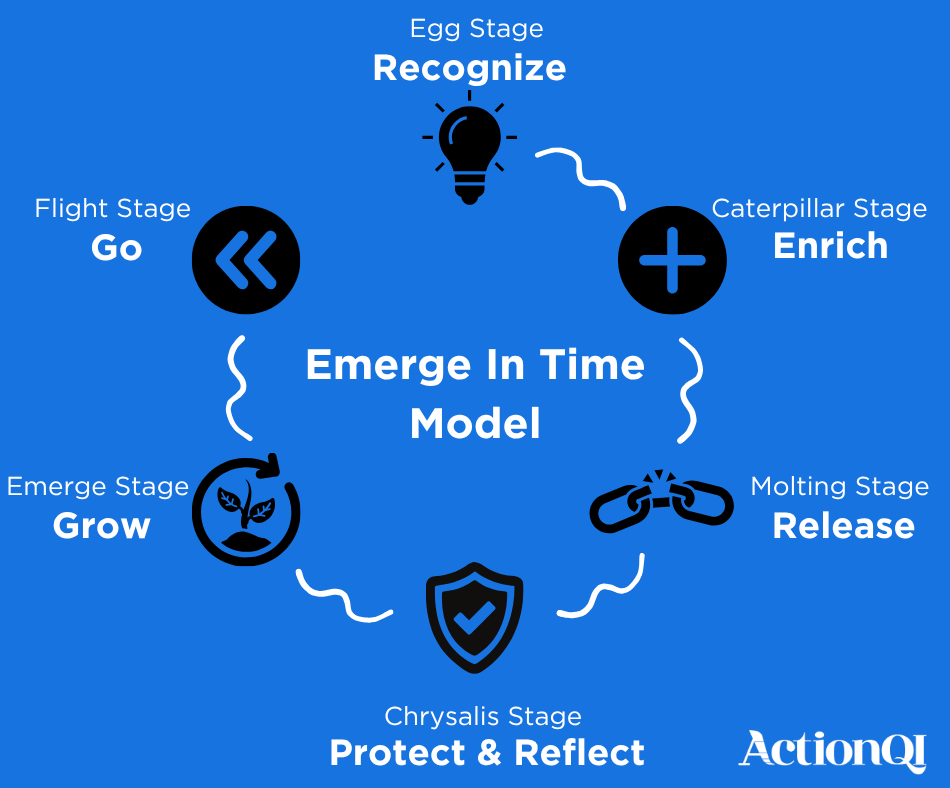
Leadership confidence rarely appears all at once. It develops through experience, reflection, and intentional adjustment as you learn what leadership actually asks of you. The Emerge In Time Model helps you understand this change as a gradual process, allowing space for practice, patience, and self-compassion while new ways of leading take shape.
Recognize – Egg Stage
In this stage, leadership discomfort becomes visible. You may notice tension between how you believe a leader should act and how leadership actually feels. Perhaps you hesitate to speak without certainty, feel pressure to have answers, or question whether you belong in the role. Awareness often arrives through moments of friction such as difficult meetings, decision fatigue, or realizing that expertise alone no longer resolves challenges.
Progress here is not confidence yet. Progress is clarity. You begin naming what feels uncomfortable and recognizing patterns rather than blaming yourself. You start seeing that leadership requires different skills than technical mastery.
Noticing discomfort is not evidence that something is wrong. It is evidence that you are becoming aware of what leadership truly involves.
Enrich – Caterpillar Stage
During Enrich, you begin adding new inputs that support leadership growth. You may seek feedback, observe how experienced leaders facilitate discussions, or intentionally practice listening, delegation, or decision framing. Instead of trying to become the expert again, you start building relational and strategic skills that leadership depends on.
This stage can feel effortful. Learning may seem slower than expected because leadership skills develop through interaction rather than memorization. You might alternate between moments of insight and moments of doubt as new behaviors feel unfamiliar.
Progress looks like experimentation. You try small adjustments, such as asking more questions instead of providing immediate solutions, or clarifying goals rather than solving problems yourself.
Feeling awkward while practicing new leadership behaviors means learning is actively happening.
Release – Molting Stage
As new understanding grows, you begin noticing beliefs or habits that no longer support you. You may recognize patterns such as needing approval before acting, equating authority with expertise, or overworking to compensate for uncertainty. Letting go of these patterns can feel uncomfortable because they once helped you succeed.
This stage often includes internal resistance. Old strategies feel safer even when they create strain. You may catch yourself stepping back into technical work or avoiding decisions, then gently redirecting yourself toward leadership responsibilities.
Progress here is not perfection. Progress is interruption. Each time you pause and choose a different response, you loosen the hold of old expectations.
Releasing familiar habits does not erase your strengths. It allows those strengths to evolve into leadership capacity.
Protect and Reflect – Chrysalis Stage
In this stage, growth becomes quieter and more internal. You begin creating boundaries that support learning, such as limiting comparison with others, seeking constructive feedback instead of constant reassurance, or allowing time to reflect after decisions. Reflection helps you see patterns in what works and what needs adjustment.
Externally, progress may not look dramatic. Internally, your understanding deepens. You begin tolerating uncertainty for longer periods and trusting your judgment even when outcomes remain unclear.
This stage requires protection because confidence is still forming. Environments that demand instant certainty or discourage learning can slow progress, making intentional reflection especially important.
Slower periods are not stagnation. They are integration, where new ways of thinking settle into stability.
Grow – Emerge Stage
Here, leadership confidence begins to feel more accessible, though not permanent or effortless. You notice increased resilience when challenges arise. Difficult conversations feel manageable rather than overwhelming, and uncertainty becomes something you can work with instead of avoid.
You may still experience doubt, but it no longer defines your decisions. You recover more quickly after mistakes and view them as information rather than personal failure. Leadership starts to feel less like performing a role and more like practicing a skill.
Progress in this stage looks like persistence. You continue leading even when outcomes vary, understanding that growth comes from repeated engagement rather than flawless execution.
Confidence is not the absence of discomfort. It is the ability to continue leading while discomfort exists.
Go – Flight Stage
In the Go stage, leadership behaviors become part of everyday practice. You naturally ask thoughtful questions, guide discussions, and support others’ expertise without feeling the need to control every outcome. Confidence feels quieter and more stable because it comes from accumulated experience rather than momentary certainty.
Challenges still occur, but they no longer threaten your sense of capability. You recognize leadership as an ongoing process rather than a destination. Growth continues through practice, reflection, and adaptation as circumstances change.
Progress here is sustainability. Leadership actions align more consistently with your values and intentions, allowing you to focus on purpose rather than self-doubt.
Leadership confidence is not something you achieve once. It is something you continue to live through steady, intentional practice over time.
Leadership confidence rarely arrives as a sudden feeling. More often, it grows quietly through understanding, reflection, and repeated experience. Simply recognizing why leading without being the expert feels uncomfortable can begin to ease the pressure many people carry without realizing it. Change tends to unfold through learning and practice over time, not through forcing certainty or trying to eliminate doubt. If you would like to explore this work more deeply, the free guide Lead with Confidence: How to Guide a Team When You’re Not the Subject Matter Expert offers practical support for navigating leadership in real situations. You are welcome to sign up as a free ActionQI member to access this and other guides whenever you feel ready to continue learning at your own pace.