
Why Honest Conversations Feel Risky When Power Isn’t Equal at Work


Honest conversations at work involve speaking openly about concerns, needs, boundaries, or disagreements in situations where outcomes matter to you. When power is unequal, honesty can feel risky because the person listening may influence your reputation, workload, opportunities, or sense of security, making openness feel both necessary and unsafe at the same time. ActionQI's Emerge In Time Model helps you view honest work conversations as a process with patience, allowing growth to happen step by step rather than expecting immediate certainty.
Why It Happens
Internal Experiences: Protection and Self-Preservation
Your mind is designed to protect stability. When a conversation could affect belonging, income, or professional standing, your nervous system often treats it as a potential threat rather than a simple discussion. You may rehearse what to say repeatedly, soften your message, delay speaking, or question whether your concerns are valid.
This is not avoidance or weakness. It is a natural response to uncertainty and possible social or professional consequences.
External Conditions: Power and Environment
Workplaces contain built-in hierarchies. Managers influence evaluations, senior colleagues shape team culture, and organizational norms determine what feels safe to say. Even when leaders intend openness, past experiences, unclear expectations, or inconsistent responses can teach people that honesty carries risk.
Over time, patterns form. Employees learn when honesty feels welcomed and when silence feels safer, often without anyone explicitly stating the rules.
Common Misconceptions
If communication is healthy, honesty should feel easy.
Honesty often feels uncomfortable when stakes are high. Discomfort does not mean something is wrong. It reflects awareness of potential consequences.
Fear means you are overthinking.
Fear frequently signals that power differences or uncertainty are real. Careful thinking can be an adaptive response, not unnecessary worry.
Good employees speak up immediately.
Timing matters. People assess safety, relationships, and readiness before speaking. Deliberation is often thoughtful self-management.
If leadership says the door is open, it is always safe to talk.
Intent and impact are different. Psychological safety develops through consistent experiences over time, not policies alone.
Avoiding the conversation means you lack confidence.
Sometimes avoidance reflects strategic protection while you gather clarity, support, or stability.
Observable Signs
Not all signs appear in every person, and experiences vary depending on role, workplace culture, and past experiences.
- Replaying conversations mentally before they happen
- Difficulty deciding how direct to be
- Softening language or minimizing concerns
- Delaying meetings or emails despite wanting resolution
- Feeling tension, fatigue, or unease before interactions with authority figures
- Seeking reassurance from trusted colleagues first
- Switching between wanting honesty and wanting to stay quiet
- Increased self-doubt about whether concerns are “valid enough”
- Overpreparing evidence or explanations to avoid misunderstanding
- Leaving conversations feeling unclear about what was actually communicated
What Helps vs. What Worsens It
What Often Helps
- Clarity about your own goal
Understanding what outcome matters most reduces internal conflict and makes conversations more focused. - Gradual preparation instead of perfection
Practicing key points or writing thoughts down helps regulate anxiety without creating pressure to say everything perfectly. - Predictable responses from leadership
Consistency builds trust over time. When reactions are steady, perceived risk decreases. - Supportive relationships at work
Discussing concerns with trusted peers or mentors helps people test ideas and feel less isolated. - Choosing timing intentionally
Conversations feel safer when emotional intensity is lower and practical conditions allow attention and listening.
What Often Worsens It
- Unclear power expectations
When roles or consequences feel ambiguous, people assume worst-case outcomes and hesitate more. - Past negative experiences with speaking up
Even a single dismissive response can shape future caution. - Pressure to resolve everything quickly
Urgency can increase fear and reduce thoughtful communication. - All-or-nothing thinking
Believing honesty must be complete or immediate can make conversations feel overwhelming. - Unpredictable reactions from others
Inconsistent feedback or shifting standards make it harder to assess safety, increasing emotional strain.
This experience is less about communication skill and more about navigating risk, relationship, and timing within real workplace structures. Understanding these patterns helps you see that your hesitation often reflects awareness and adaptation, not personal failure.
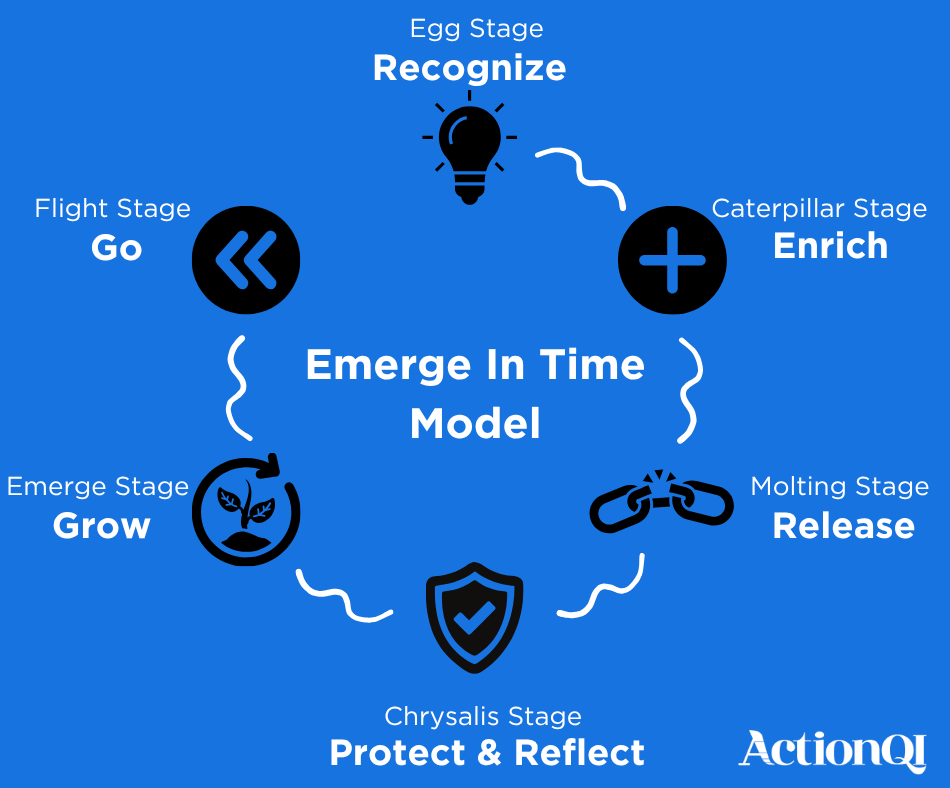
Understanding Change Over Time with the Emerge In Time Model
Honest conversations at work rarely become easier through a single moment of courage. Change tends to unfold gradually as understanding, preparation, and confidence develop in with practice and time. The Emerge In Time Model helps you view this process with patience, allowing growth to happen step by step rather than expecting immediate certainty.
Recognize — Egg Stage
At this stage, you begin noticing that something feels misaligned. You may feel tension before meetings, replay conversations afterward, or sense that you are holding back parts of what you want to say. Awareness grows around power differences, communication patterns, and the emotional weight attached to speaking honestly. Rather than solving the situation, you are learning to name what is happening and why it affects you.
Progress here looks like clarity, not action. You may start identifying triggers, recognizing recurring situations, or understanding how workplace dynamics influence your reactions. Simply acknowledging that the risk feels real can reduce confusion.
Noticing discomfort is not falling behind. Awareness is the foundation that makes thoughtful change possible.
Enrich — Caterpillar Stage
During Enrich, you begin gathering what supports safer communication. This might include learning communication skills, observing how others navigate difficult discussions, strengthening professional relationships, or clarifying your own values and boundaries. You are building internal and external resources that make honesty more sustainable.
You may experiment privately by writing down what you wish you could say or practicing clearer language in lower-stakes conversations. Confidence grows slowly as understanding replaces uncertainty.
Progress looks like preparation rather than confrontation. You are expanding capacity, not forcing outcomes.
Preparation is active growth. You are not delaying honesty; you are creating the conditions that allow it to land more clearly.
Release — Molting Stage
Here, you begin letting go of beliefs or habits that no longer support you. You may notice patterns such as overexplaining, assuming negative outcomes, or believing you must either stay silent or say everything perfectly. Releasing does not mean becoming fearless. It means loosening attachment to strategies that once protected you but now limit expression.
This stage often feels uncomfortable because familiar coping methods are changing while new ones still feel uncertain. You might start speaking slightly more directly or allowing pauses instead of immediately smoothing tension.
Progress looks subtle. Even small shifts in how you think or respond signal movement.
Letting go is not losing protection. It is updating protection so it fits your current reality.
Protect and Reflect — Chrysalis Stage
In this stage, you intentionally create stability while integrating what you have learned. You may choose when and where conversations happen more carefully, set boundaries around emotional energy, or seek supportive environments before addressing sensitive topics. Reflection becomes important as you evaluate what worked, what felt safe, and what needs adjustment.
Externally, little may appear to change, but internally significant restructuring is occurring. You are learning to protect your well-being while still moving toward honesty.
Progress looks like thoughtful pacing and self-trust. You begin recognizing that timing and context matter as much as words.
Stepping back to reflect is not avoidance. It is how sustainable change strengthens.
Grow — Emerge Stage
At Grow, you begin having more honest conversations, though they may still feel imperfect. Some interactions go well, while others feel awkward or incomplete. Instead of interpreting outcomes as success or failure, you start recognizing each experience as information that builds resilience.
You may notice reduced rumination afterward or greater ability to stay grounded during discussions. Confidence develops through experience rather than certainty beforehand.
Progress looks like willingness to try again, even when results vary. Growth becomes linked to learning rather than flawless performance.
Progress is measured by participation, not perfection.
Go — Flight Stage
In the Go stage, honest communication becomes more integrated into everyday work life. You no longer view difficult conversations as rare events requiring extraordinary effort. Instead, honesty becomes part of how you collaborate, set expectations, and maintain professional relationships over time.
You still assess power dynamics, but they feel more navigable. Decisions about when to speak, how direct to be, and what boundaries to hold become more intuitive.
Progress here looks like consistency. Honest conversations are practiced regularly in ways that align with your values and professional stability.
Lasting change is not a final state. It is the ongoing practice of showing up with awareness and intention as situations evolve.
Understanding why honest conversations feel risky when power is unequal can already shift how you relate to yourself at work. Awareness often comes before confidence, and clarity often arrives before change becomes visible. You do not need to force readiness or rush toward difficult conversations. Growth tends to unfold through noticing, learning, trying, and adjusting over time. If you would like to continue exploring this topic at your own pace, the free guide Speak Up with Respect: Navigating Crucial Conversations with Higher-Ranked Colleagues offers practical support for approaching honest conversations with greater steadiness and care. You are welcome to sign up as a free ActionQI member to access this and other guides whenever they feel useful, returning to them when the timing feels right for you.