
The Emerge In Time Model

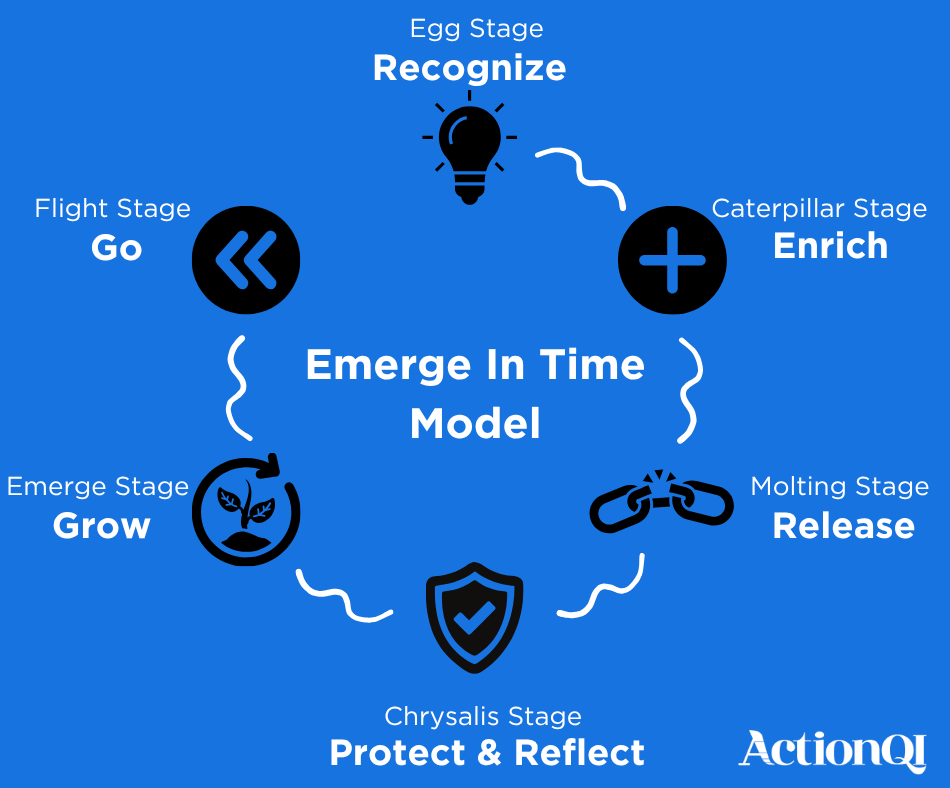
The Emerge In Time Model is a six-stage personal growth framework inspired by the butterfly's lifecycle, showing how awareness, nourishment, release, protection, resilience, and sustained action work together to create meaningful change. While the stages follow a natural developmental flow, Emerge In Time is not a rigid process. It’s a learning-based model that allows people to move between stages, revisit earlier ones, or pause without stalling growth.
Within Emerge In Time, difficulty is not an invitation to react, withdraw, or prove oneself, but an opportunity to learn what will truly serve long-term growth. An unkind coworker, for instance, is not a cue to return hostility, but a moment to step back, understand what is happening, and choose a response that protects self-respect and supports a better future.
Not every challenge is an opponent; some are teachers.
Why the Butterfly's Lifecycle Matters
The Emerge In Time Model is intentionally structured to mirror the butterfly’s lifecycle, reflecting the natural sequence required for growth: awareness precedes nourishment, nourishment requires release, transformation needs protection, growth emerges through resilience, and flight is sustained through practice. While the butterfly's lifecycle provides the developmental logic of the Emerge In Time Model, human growth differs from biological growth in one key way: learning allows revisiting earlier stages with greater awareness and capacity.
In other words:
- The lifecycle gives order
- Learning gives flexibility
We encourage you to go through the Emerge In Time stages in sequence when first encountering a challenge. However, as awareness grows, it may become necessary to revisit earlier stages, such as Enrich or Release, when new insights emerge or circumstances change.
At times, you may skip a stage you are not ready for and return to it later. This is not avoidance; it is adaptive learning.
The goal of the Emerge In Time Model is not to complete stages, but to continue learning without stalling growth.
Learning keeps growth moving, even when progress is non-linear.
The Six Stages of the Emerge In Time Model
Each stage of the Emerge In Time Model builds understanding that enables growth in the next stage.
- Egg Stage — Recognize
Function: Awareness before action
In the Emerge In Time Model, the Egg Stage begins at the moment of disruption: when a challenge, conflict, loss, or emotional reaction signals the possibility for growth rather than collapse. Recognize is the stage of understanding the situation clearly: what is happening, what caused it, what triggers it, how you respond, and what needs improvement.
Butterfly parallel:
- The egg contains potential, not movement.
- Nothing changes yet — conditions are being identified.
Key characteristics:
- Observation without pressure to act
- Identifying triggers, patterns, and responses
- Naming the real problem
Awareness is the prerequisite for growth, not a delay to it.
A common misconception is that recognition means knowing what to fix immediately. In Emerge In Time, recognition comes before intervention.
- Caterpillar Stage — Enrich
Function: Nourishment and capacity-building
Enrich focuses on adding supportive inputs: knowledge, skills, habits, and experiences, that strengthen the individual and prepare them for change.
Butterfly parallel:
- The caterpillar’s primary role is to consume and grow.
- Growth here is about capacity, not transformation.
Key characteristics:
- Learning and skill development
- Introducing positive behaviors
- Building internal resources
Growth requires nourishment before transformation.
An important distinction is that Enrich is not about fixing weaknesses; it is about building strength.
- Molting Stage — Release
Function: Removing constraints
Release involves identifying and letting go of beliefs, behaviors, or practices that no longer serve growth.
Butterfly parallel:
- The caterpillar must shed its skin to continue growing.
- What once protected now restricts.
Key characteristics:
- Subtraction rather than addition
- Releasing outdated coping strategies
- Creating space for change
What enabled survival at one stage in life can limit growth at the next. Progress often accelerates when resistance is reduced.
- Chrysalis Stage — Protect and Reflect
Function: Stabilization and integration
Protect and Reflect is the stage where individuals create boundaries against harmful influences while reflecting on progress, adjusting behaviors, and integrating lessons learned.
Butterfly parallel:
- Inside the chrysalis, transformation occurs out of view.
- Protection enables reorganization.
Key characteristics:
- Reduced external noise
- Reflection and self-monitoring
- Strategic adjustments
Transformation requires protection, not pressure. Stillness in this stage is not stagnation, it is reorganization.
- Emerge Stage — Grow
Function: Resilience through iteration
Grow emphasizes resilience, recognizing that every attempt, successful or not, contributes to learning, confidence, and personal development.
Butterfly parallel:
- The butterfly emerges imperfect and vulnerable.
- Strength develops through effort and adaptation.
Key characteristics:
- Learning from setbacks
- Building resilience
- Reframing failure as feedback
Growth is not the absence of failure, but the use of it. Confidence is a result of repeated emergence, not a prerequisite.
- Flight Stage — Go
Function: Sustained, purposeful action
Go represents the continuous practice of improved behaviors and the integration of personal growth into everyday life and purpose.
Butterfly parallel:
- Flight is not a single moment, it is ongoing movement.
- Survival depends on continued use of new capabilities.
Key characteristics:
- Consistency over intensity
- Alignment with purpose
- Adaptation over time
Flight is sustained through practice, not achieved once. Go is not an endpoint; it is a living stage.
The Emerge In Time Model encourages continued movement through learning, even when progress feels uneven. You may move forward, pause, revisit, or redirect, but as long as learning continues, growth does too. You don’t stall because you revisit a stage; you stall when you stop learning. Visit our blog to view articles that help you see how the Emerge In Time Model can be applied to situations you may be navigating.