
How Parental Abandonment Shapes Identity, Trust, and Emotional Safety


Understanding Parental Abandonment
Parental abandonment is the experience of a parent becoming emotionally or physically unavailable in a way that leaves a child without expected care, protection, or connection. It is not only about a parent leaving or being absent. It is about the lasting feeling of being unsupported, unseen, or unsafe in a relationship that was meant to provide stability. Over time, this experience can shape how you understand yourself, how safe relationships feel, and whether trust seems reliable or risky. ActionQI's Emerge In Time Well Model helps organize this process into intentional stages, allowing you to approach healing with patience, self-compassion, and realistic expectations about growth.
Why It Happens
Human and Emotional Factors
Parental abandonment rarely comes from a single decision or moment. It often emerges from patterns shaped by a parent’s own emotional capacity, unresolved trauma, mental health struggles, addiction, or difficulty sustaining stable relationships. Some parents withdraw because they lack the emotional tools to remain present during stress, conflict, or responsibility.
In many cases, abandonment reflects limitation rather than intention. A parent may care deeply yet still be unable to provide consistent emotional safety.
Environmental and Systemic Factors
External pressures also play a significant role. Financial instability, illness, migration, incarceration, family conflict, cultural expectations, or unsafe living conditions can disrupt caregiving relationships. Systems meant to support families sometimes fail to provide enough stability, leaving both parents and children without adequate support.
Understanding these patterns helps shift the question from “Why did this happen to me?” toward “What conditions made this outcome more likely?” That shift often reduces self-blame and increases clarity.
Common Misconceptions
Parental abandonment means a parent did not love you.
Love and capacity are not the same. A parent may have had emotional attachment while lacking the stability or skills needed to remain present.
You should be over it by now.
Identity and emotional safety develop over many years. Experiences that shaped them tend to resurface during new life stages or relationships.
Only physical absence counts as abandonment.
Emotional unavailability, chronic unpredictability, or repeated withdrawal can create similar internal effects even when a parent was physically present.
Healing means forgetting or forgiving quickly.
Understanding and integration usually come before forgiveness, and forgiveness itself is not required for growth.
Strong independence proves abandonment no longer affects you.
Self-reliance can be a strength, but it can also develop as protection against disappointment or emotional risk.
Observable Signs
Not all signs appear in every person, and experiences vary widely. These patterns simply reflect ways people often adapt to disrupted emotional safety.
- Difficulty trusting consistency in relationships, even when others behave reliably
- Sensitivity to rejection, distance, or changes in communication
- Feeling responsible for maintaining relationships or preventing conflict
- Strong independence paired with discomfort relying on others
- Fear of being “too much” or “not enough” for people close to you
- Emotional withdrawal during stress or vulnerability
- Overanalyzing interactions to predict potential abandonment
- Challenges identifying personal needs or asking for support
- A persistent sense of emotional uncertainty, even in stable environments
- Alternating between closeness and distancing in relationships
These responses are often adaptive strategies that once helped create emotional safety.
What Often Helps vs. What Often Worsens It
What Often Helps
- Consistent relationships over time
Predictability gradually rebuilds emotional safety more effectively than intense but short-lived connection. - Naming and understanding the experience
Making sense of past patterns helps separate identity from what happened. - Slow trust-building
Allowing trust to develop in small, repeatable experiences reduces emotional overwhelm. - Self-awareness without self-judgment
Recognizing protective behaviors as learned responses creates space for change. - Intentional personal growth frameworks
Structured reflection, such as moving intentionally through stages of the Emerge In Time Well Model, helps people plan change rather than forcing emotional breakthroughs.
What Often Worsens It
- Pressure to “move on” quickly
Urgency can reinforce feelings of being misunderstood or emotionally unsafe. - All-or-nothing relationship expectations
Expecting immediate certainty or complete safety can make normal relationship challenges feel threatening. - Self-blame or comparison
Interpreting emotional responses as personal weakness deepens shame rather than understanding. - Repeated exposure to unpredictable relationships
Instability can reinforce earlier patterns instead of allowing new experiences to reshape expectations. - Avoiding reflection entirely
Suppressing the experience may reduce short-term discomfort but often keeps underlying identity and trust patterns unchanged.
Change tends to unfold when understanding grows at a pace that feels emotionally manageable. The goal is not to erase the past, but to gradually reshape how safety, identity, and trust are experienced moving forward.
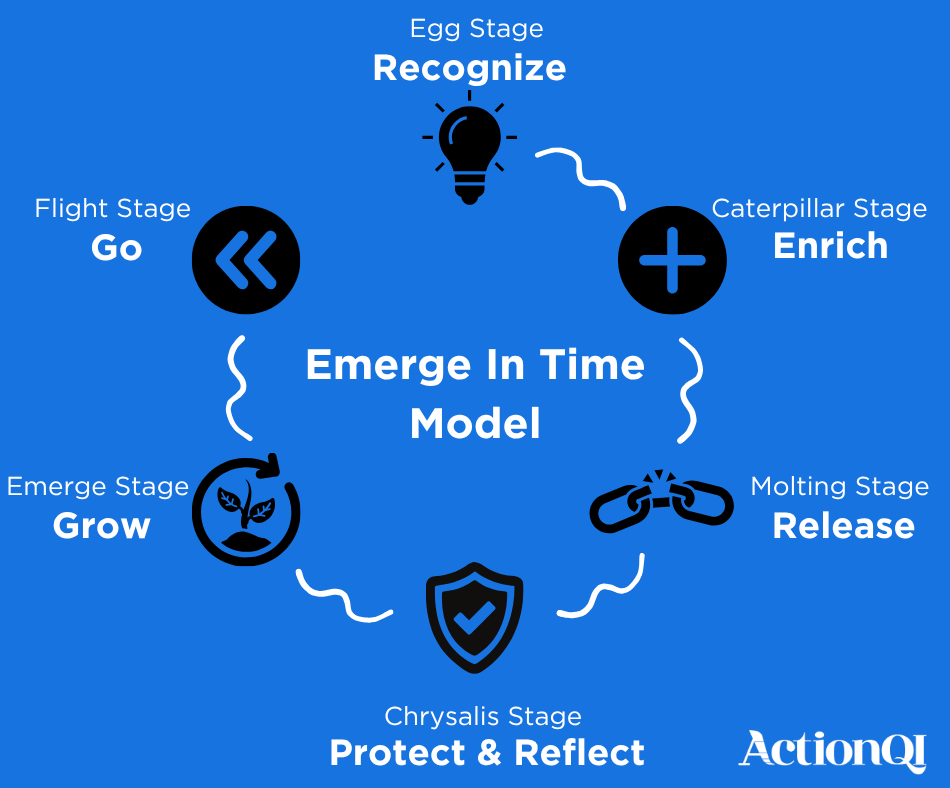
Understanding Change Over Time
Experiences connected to parental abandonment rarely shift through a single insight or decision. Change tends to unfold gradually as understanding, emotional safety, and new patterns develop through practice. The Emerge In Time Model helps organize this process into intentional stages, allowing you to approach healing with patience, self-compassion, and realistic expectations about growth.
Recognize (Egg Stage)
Awareness Before Action
At this stage, parental abandonment often appears as confusion rather than clarity. You may notice repeating relationship patterns, emotional reactions that feel larger than the situation, or a persistent sense of insecurity without fully understanding why. Memories, triggers, or relationship struggles begin to connect into a recognizable pattern. The focus is not fixing anything yet, but understanding what has shaped your sense of identity, trust, and emotional safety.
Progress here looks like naming experiences without minimizing or exaggerating them. You begin to see that certain responses developed for protection, not because something is wrong with you. Awareness may feel uncomfortable because it challenges long-held assumptions about yourself or your past.
Understanding is already movement. Recognizing patterns is not dwelling on the past. It is learning the landscape before choosing where to go next.
Enrich (Caterpillar Stage)
Adding What Was Missing
During Enrich, attention shifts toward building internal resources that support stability. After parental abandonment, this may involve learning emotional language, developing boundaries, practicing self-support, or experiencing relationships that model consistency. You may actively seek knowledge, therapy, reflection practices, or supportive communities that help expand how safety feels.
Progress is often quiet and practical. You might pause before reacting, identify your needs more clearly, or tolerate closeness slightly longer than before. Growth can feel uneven because new skills are still unfamiliar.
Growth does not require immediate confidence. Gathering tools and experiences is enough for this stage. Just as nourishment supports development before visible transformation occurs, enrichment prepares change long before results are obvious.
Release (Molting Stage)
Letting Go of Protective Patterns
Here, you begin noticing behaviors and beliefs that once protected you but now limit connection or self-trust. This may include hyper-independence, people-pleasing, emotional withdrawal, or assumptions that relationships will eventually become unsafe. Releasing does not mean rejecting parts of yourself. It means recognizing which strategies belong to past conditions rather than present reality.
Progress often looks like small risks: expressing a need, tolerating uncertainty, or allowing others to show up without immediately preparing for disappointment. Letting go can feel vulnerable because familiar protections are loosening before new stability feels fully secure.
Releasing is not losing protection. It is updating protection so it fits your current life rather than past survival needs.
Protect and Reflect (Chrysalis Stage)
Stability and Inner Adjustment
This stage emphasizes creating emotional safety while change takes root. After experiences of abandonment, you may become more selective about relationships, environments, and influences. Reflection deepens as you observe what supports stability and what disrupts it. Periods of withdrawal or quiet processing are common and often necessary.
Progress here is internal rather than visible. You may notice greater emotional regulation, clearer boundaries, or an increased ability to pause and reflect instead of reacting automatically. Growth can feel slow because much of the work happens beneath the surface.
Slowing down is not regression. Protection and reflection allow change to consolidate, giving new patterns time to become reliable rather than temporary.
Grow (Emerge Stage)
Resilience Through Experience
In the Grow stage, you begin experiencing yourself differently in real situations. Relationships may feel less threatening, and emotional setbacks become learning experiences rather than proof of failure. You recognize that trust develops through repeated experiences, not certainty.
Progress appears as resilience. You recover more quickly from disappointment, communicate more openly, or remain present during emotional discomfort. Growth includes attempts that do not go perfectly, yet still expand your capacity for connection and self-understanding.
Progress is measured by responsiveness, not perfection. Each attempt, successful or messy, strengthens emotional flexibility and confidence.
Go (Flight Stage)
Living the Change
At this stage, new patterns become part of everyday life. The influence of parental abandonment may still exist, but it no longer defines your identity or determines your choices. Trust, boundaries, and emotional safety become ongoing practices rather than constant struggles.
Progress looks like consistency. You make decisions aligned with your values, maintain relationships with greater balance, and return to supportive habits when challenges arise. Change feels integrated rather than effortful.
Arrival is not the goal. Living well means continuing to practice what supports you, allowing growth to remain active and adaptable as life evolves.
Understanding how parental abandonment has shaped your identity, trust, and emotional safety is already meaningful movement. Insight often arrives before visible change, and simply recognizing patterns or naming experiences can begin to soften confusion that may have lived quietly for years. Growth in this area tends to unfold gradually through reflection, practice, and compassionate awareness rather than pressure or force. If you feel ready to continue exploring at your own pace, The Journey of Forgiveness: Healing from Parental Abandonment offers deeper guidance and supportive pathways for working with these experiences. You are welcome to sign up as a free member to access this and other guides whenever it feels right, allowing learning and healing to develop in ways that match your timing and capacity.