
How Financial Mistakes Erode Trust in Close Relationships


Financial trust is the sense that money related decisions, disclosures, and responsibilities in a close relationship are handled with honesty, care, and shared respect. When financial mistakes happen, that trust can weaken not only because of the money itself, but because the mistake may feel like secrecy, avoidance, or a lack of consideration for how the other person is affected. The experience often shows up as unease, second-guessing, or a quiet feeling that something important no longer feels fully safe or predictable. ActionQI's Emerge In Time Model helps you see progress in financial trust as a sequence you move through with intention and self-compassion, rather than something you are expected to fix all at once.
Why Financial Trust Is Vulnerable
Internal contributors
Financial trust is closely tied to how people manage fear, responsibility, and self-worth. Money often carries emotional weight around security, competence, and independence, so a mistake can trigger shame or defensiveness. When someone feels overwhelmed or afraid of disappointing a partner, they may delay disclosure, minimize the issue, or avoid conversations altogether. Over time, these protective behaviors can unintentionally signal distance or unreliability, even when there was no intent to deceive.
External contributors
Financial trust also forms within real pressures like rising costs, debt, uneven income, cultural expectations, and different money histories. Close relationships add another layer because decisions rarely affect only one person. Patterns emerge when stress is ongoing, communication feels risky, or roles around money are unclear. Trust tends to erode not from a single error, but from repeated moments where expectations, information, or accountability feel misaligned.
Common Misconceptions About Financial Trust
If it was an honest mistake, trust should not be affected.
Even honest mistakes can impact trust when they change a shared sense of safety or predictability. Trust is shaped by how situations are handled, not only by intent.
Talking about money problems will only make things worse.
Avoidance often increases tension over time. Careful, grounded conversations usually reduce uncertainty, even when the topic is uncomfortable.
Loss of financial trust means the relationship is broken.
A strain in trust signals that something important needs attention, not that the relationship is beyond repair. Trust can change and rebuild through intentional effort over time.
The problem is just the money.
Money is often the surface issue. Underneath are concerns about honesty, consideration, shared responsibility, and feeling included in decisions.
This needs to be fixed immediately or it will never recover.
Urgency can create pressure and defensiveness. Trust typically rebuilds through consistent patterns, not quick solutions. Understanding what happened is already part of progress.
Observable Signs
People experience financial trust strain in different ways. You may notice some of the following, or only a few. The presence of these signs does not mean anything is wrong with you or your relationship.
- Feeling uneasy or tense when money comes up, even in casual conversations
- Mentally replaying past financial decisions or conversations and questioning what was shared
- Hesitating to ask questions about spending, debt, or accounts
- Noticing a pull to monitor finances more closely than before
- Withdrawing from joint planning or avoiding financial topics altogether
- Feeling surprised or caught off guard by expenses or financial updates
- Interpreting small money choices as signals of larger issues
- Experiencing a loss of ease or openness around shared decisions
What Often Helps
- Clear, paced communication that matches emotional readiness
- Acknowledging impact before trying to explain or solve
- Sharing information consistently, even when nothing urgent is happening
- Naming uncertainty or limits instead of filling gaps with assumptions
- Allowing trust to rebuild through repeated, ordinary follow-through
- Separating understanding from immediate action or resolution
What Often Worsens It
- Rushing conversations before both people feel steady enough to engage
- Withholding details to avoid conflict or discomfort
- Treating one conversation as a final reset rather than part of a pattern
- Focusing only on numbers while ignoring emotional meaning
- Using reassurance without accompanying transparency
- Letting silence or ambiguity linger for long periods
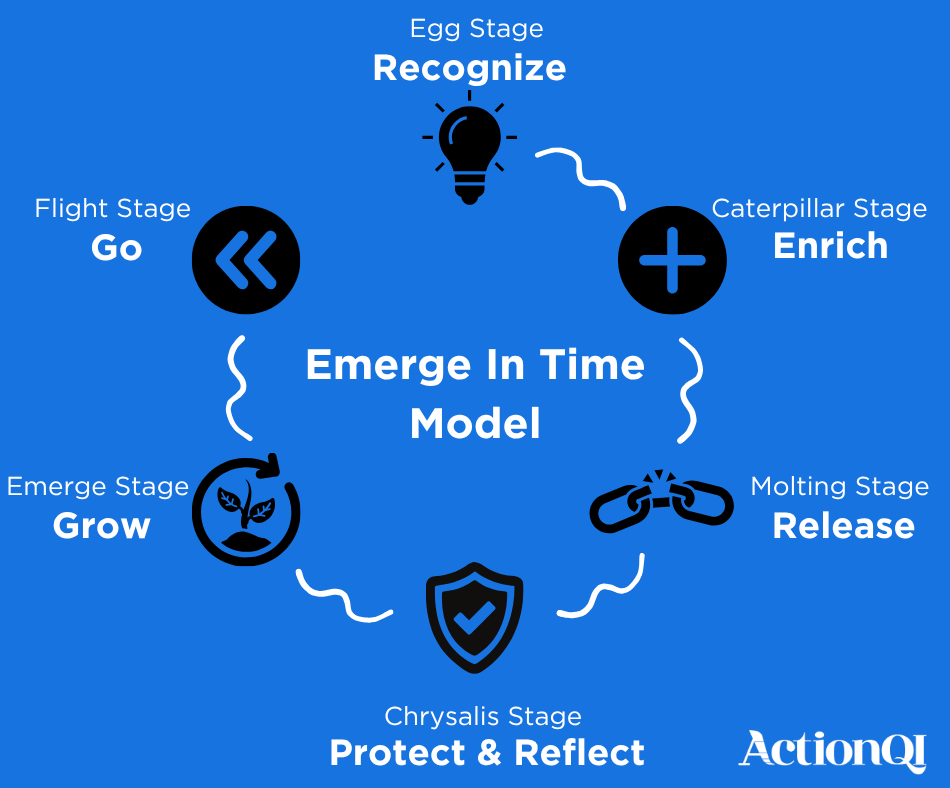
Understanding Financial Trust as a Process of Change
Financial trust rarely shifts because of one conversation or decision. It changes through understanding, timing, and repeated experiences that rebuild a sense of safety. The Emerge In Time Model helps you see this as a process you move through with intention and self-compassion, rather than something you are expected to fix all at once.
Recognize — Egg stage: Awareness Before Action
In this stage, financial trust shows up as discomfort, confusion, or a quiet sense that something feels off. You may be replaying moments where information was missing, decisions felt unilateral, or financial surprises left you unsettled. This stage is less about solving and more about noticing patterns, triggers, and emotional responses without rushing to conclusions.
Progress here looks like naming what you are experiencing in clear, neutral language. You might realize that the issue is not a single expense but repeated uncertainty, or that the emotional reaction is stronger than the numbers alone would explain. Simply seeing the situation more accurately is meaningful movement.
Clarity is not delay. Taking time to understand what is happening is an act of care, not avoidance.
Enrich — Caterpillar Stage: Adding What Was Missing
During Enrich, financial trust begins to shift through new inputs rather than corrections. You may be learning how money stress affects you emotionally, how your partner relates to finances, or how communication patterns formed over time. This can include gaining practical knowledge, but it also includes learning language for discussing impact, expectations, and shared responsibility.
Progress looks like feeling slightly more resourced. Conversations may still feel awkward, but they are less paralyzing. You may notice moments of increased openness, curiosity, or willingness to ask questions you once avoided. The goal is not resolution, but support for steadier engagement.
Learning does not mean you were doing it wrong before. It means you are building capacity for what comes next.
Release — Molting Stage: Letting Go of What No Longer Helps
In Release, attention turns to patterns that quietly undermine financial trust. This might include avoiding conversations to keep the peace, assuming intent without checking, or holding onto beliefs like “bringing this up will only cause problems.” These habits often formed to protect the relationship, even if they now create distance.
Progress looks like loosening your grip on these responses, even briefly. You might pause before jumping to conclusions or notice when silence is driven by fear rather than choice. Letting go does not require certainty, only willingness to stop repeating what no longer works.
Releasing a pattern does not erase your history. It honors what you needed then while making room for something more supportive now.
Protect and Reflect — Chrysalis Stage: Creating Stability While You Learn
This stage focuses on containment and reflection. Financial trust can feel fragile here, so it helps to protect yourself from overload while observing what supports steadiness. This might mean setting boundaries around timing, limiting reactive discussions, or agreeing on basic transparency practices while emotions settle.
Progress looks like increased predictability. You may notice fewer emotional spikes, clearer expectations, or a growing sense that you can engage without bracing yourself. Reflection helps you adjust what is working and what still feels tender.
Protecting your energy is not shutting down. It is creating the conditions where trust has room to rebuild.
Grow — Emerge Stage: Learning Through Real Attempts
In Grow, financial trust develops through lived experience rather than planning alone. You are trying new ways of communicating, sharing information, or making decisions together, and seeing what happens. Some attempts will feel grounding, others may miss the mark, and both contribute to learning.
Progress looks like resilience. Instead of interpreting setbacks as proof that trust cannot return, you begin to see them as data. You recover more quickly, talk things through with less fear, and recognize improvement even when things are not perfect.
Growth includes missteps. Each attempt adds information that strengthens your ability to move forward.
Go — Flight Stage: Living the Change Over Time
In Go, financial trust becomes part of daily life rather than a focused project. Transparency, communication, and shared awareness are practiced consistently, even when there is no immediate issue. Trust here is not the absence of mistakes, but confidence in how they will be handled.
Progress looks like ease. Money conversations feel more ordinary and less charged. You trust your ability to address problems as they arise, without spiraling into old patterns. The relationship holds more flexibility and less vigilance.
Sustained trust is built through ordinary moments. What you practice regularly matters more than what you resolve once.
If financial trust feels clearer than it did before, even slightly, that understanding matters. Not because it demands action, but because clarity often softens pressure and creates space to respond more thoughtfully over time. Change around trust rarely comes from force or quick decisions. It grows through noticing patterns, learning what steadies you, and allowing insight to settle before asking anything more of yourself.
If you’re ready to take the next step, you may want to explore this topic more deeply through our free guide Restoring Financial Trust: Rekindle Relationships After Financial Blunders. It offers supportive ways to think through financial trust and its repair at a pace that respects where you are. Becoming a free member gives you access to this guide and others, so you can return, reflect, and move forward when it feels right.