
Confidence After Setbacks


Confidence after setbacks is the sense of self-trust that often weakens after something goes wrong, even when your desire to keep going is still there. It can feel like hesitating to rely on your own judgment, second-guessing past choices, or feeling unsure whether effort will lead to a different outcome this time. The core experience is not a loss of motivation, but a quiet break in trust between you and yourself. ActionQI's Emerge In Time Model helps you see confidence after setbacks as rebuilding through stages, instead of a single decision.
Why Confidence After Setbacks Happens
How self-trust erodes before motivation does
After a setback, your mind naturally starts scanning for risk. You may replay what happened, look for what you missed, or question whether your judgment can be relied on. This is not weakness or pessimism. It is a protective pattern. Confidence weakens because trust depends on predictability, and a setback interrupts the sense that your actions lead to expected results. Motivation can still be present, but without trust, it has nowhere steady to land.
Over time, repeated or meaningful setbacks can create a pattern where effort feels risky. You may still want progress, but hesitate to act because your system has learned that trying does not always lead to safety or reward. From an Emerge In Time perspective, this often shows up early in the process, before clarity or confidence has had time to rebuild through understanding and integration.
The role of environment, relationships, and systems
Confidence does not live only inside you. It is shaped by feedback, consequences, and context. Unsupportive workplaces, unclear expectations, sudden changes, or criticism without guidance can all weaken self-trust. When mistakes are punished or ignored rather than understood, the lesson learned is not how to improve, but how to avoid exposure.
Relational dynamics matter too. If others lose trust in you quickly, or if support disappears after a setback, your own confidence may follow. Over time, these external pressures interact with internal responses, reinforcing the pattern. Seen this way, loss of confidence is not a personal flaw. It is an understandable response to repeated uncertainty and disrupted learning.
Common Misconceptions
If I were really motivated, my confidence would come back.
Motivation and confidence are different. You can want change deeply and still not trust your ability to create it yet. Treating confidence as a motivation problem often leads to frustration rather than progress.
Losing confidence means I am weak or incapable.
Loss of confidence after setbacks is a common human response to unpredictability and risk. It reflects a nervous system trying to protect you, not a lack of ability or strength.
I just need one win to fix this.
Small successes can help, but confidence usually rebuilds through understanding patterns, not isolated outcomes. Without learning and integration, even wins can feel fragile or undeserved.
I should push through this hesitation.
Urgency can increase pressure without restoring trust. Confidence tends to return when actions feel informed and proportionate, not forced.
Other people bounce back faster than I do.
What looks like quick recovery often hides support, context, or prior learning you cannot see. Comparing timelines usually adds shame and obscures what your own process needs right now.
Observable Signs
Not everyone experiences confidence after setbacks in the same way. You may recognize some of the signs below, or none at all. These patterns often shift over time.
Emotional signs
- A muted or cautious emotional tone after a setback, even when you care about the outcome
- Feeling discouraged without feeling fully hopeless
- Anxiety or tension when thinking about trying again
Cognitive signs
- Second-guessing decisions that once felt clear
- Overanalyzing past mistakes to prevent repetition
- Difficulty trusting your own judgment, even with familiar tasks
Behavioral signs
- Hesitating to take action despite wanting progress
- Delaying decisions or seeking excessive reassurance
- Reducing effort in areas where effort once felt safe
Situational signs
- Confidence dropping more sharply in high-visibility or high-stakes settings
- Feeling more capable in private than when others are watching
- Avoiding contexts that resemble the original setback
What Often Helps
- Time and space to understand what happened, without pressure to immediately act
- Support that focuses on learning and context, not evaluation or comparison
- Breaking experiences into smaller, lower-risk steps that allow trust to rebuild gradually
- Clear expectations and feedback that reduce uncertainty
- Recognizing which stage of the Emerge In Time process you are in, especially early stages where understanding comes before action
What Often Worsens It
- Pushing for quick confidence before trust has had time to recover
- High-pressure environments that emphasize outcomes over learning
- Repeated exposure to similar setbacks without reflection or adjustment
- Harsh self-talk or external messaging that frames hesitation as a character flaw
- Acting before readiness, which can reinforce the sense that effort is unsafe
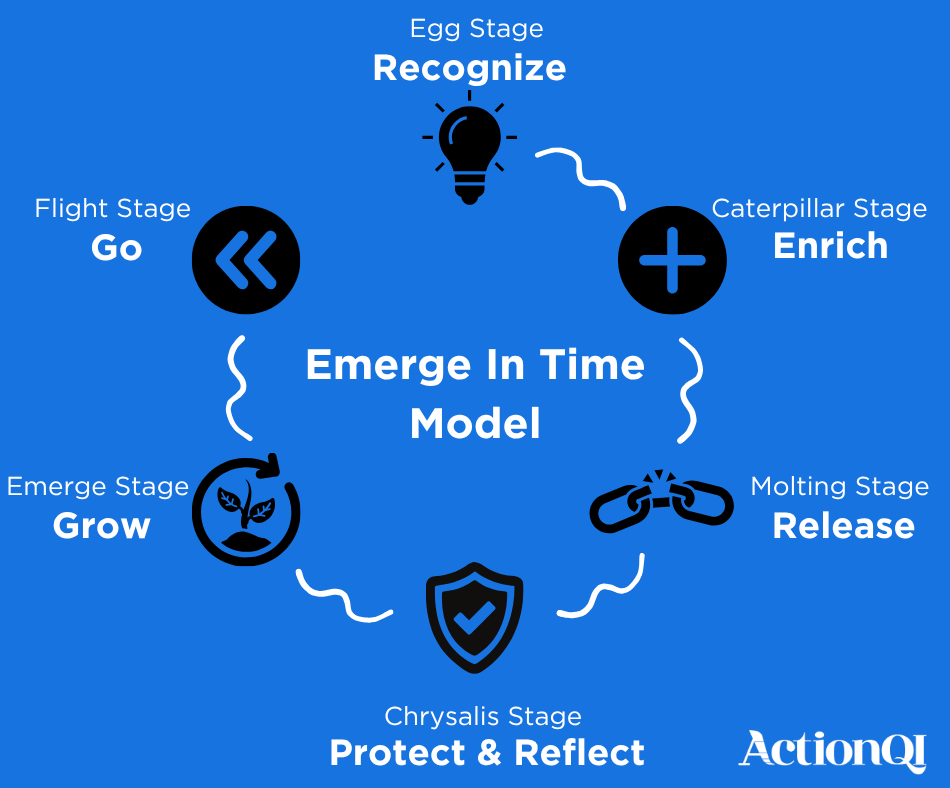
How Change Unfolds Over Time After Setbacks
Confidence after setbacks rarely returns through a single decision or push of will. It tends to rebuild through stages, as understanding comes first, then support, then readiness for action. The Emerge In Time Well Model helps make sense of this by framing change as a sequence that respects timing, learning, and self-compassion rather than urgency.
Recognize — Egg Stage
In this stage, confidence after setbacks often feels fragile or absent. You may notice hesitation, doubt, or a sense that something shifted inside you, even if you cannot yet explain it clearly. You might replay what happened, wonder where things went wrong, or feel confused about why motivation is present but trust is not.
Progress here looks like awareness, not resolution. Naming that your confidence changed after a setback is already movement. You may begin to notice patterns in when doubt appears or what situations feel most activating.
Not knowing what to do yet does not mean you are stuck. It means you are gathering the information needed for safer next steps.
Enrich — Caterpillar Stage
Here, confidence is still inconsistent, but curiosity starts to return. You may look for explanations, language, or tools that help you understand your experience without blaming yourself. Learning feels supportive rather than demanding. You are not trying to prove anything yet.
Progress shows up as nourishment. This can include gaining insight, hearing your experience reflected accurately, or learning skills that lower the sense of risk. Confidence is not restored yet, but it is being fed.
Building understanding is not avoidance. It is how trust begins to rebuild from the inside.
Release — Molting Stage
At this stage, you may notice beliefs or habits that once felt protective now feel heavy. These can include harsh self-judgments, unrealistic expectations, or the idea that you must feel confident before acting. Letting go can feel uncomfortable because these patterns once helped you cope.
Progress here looks like loosening rather than fixing. You may catch yourself pausing old reactions or questioning whether they still serve you. Confidence is not stronger yet, but the weight holding it down is easing.
Releasing what no longer fits is a form of strength, even when it feels uncertain.
Protect and Reflect — Chrysalis Stage
Confidence is tender in this stage. You may need more boundaries, quieter conditions, or fewer opinions from others. Reflection becomes important as you make sense of what you are learning about yourself and your responses to setbacks.
Progress appears as stability. You protect your energy, reflect on what helps or harms your confidence, and make small adjustments. Trust grows through consistency rather than exposure.
Creating safety is not retreating. It is preparing the conditions for confidence to return.
Grow — Emerge Stage
Here, confidence begins to shift from fragile to flexible. You may still feel nervous, but attempts no longer feel as threatening. Setbacks are seen as information rather than proof of failure. Effort feels meaningful again, even when outcomes are mixed.
Progress shows up as resilience. You try, adjust, and try again with less self-blame. Confidence grows because you are learning you can respond, not because everything goes perfectly.
Confidence does not mean certainty. It means trusting your ability to respond.
Go — Flight Stage
In this stage, confidence becomes part of daily life rather than something you monitor closely. You act with an understanding that setbacks are possible and manageable. Trust in yourself feels lived rather than questioned.
Progress here is continuity. You keep practicing supportive behaviors and making choices aligned with what you have learned. Confidence is no longer about avoiding setbacks, but about moving with them.
Ongoing practice is not maintenance of a problem. It is the natural rhythm of growth.
Confidence after setbacks does not return because you push harder or decide to be different. It rebuilds as understanding deepens and as your system learns, again and again, that effort can be approached with care rather than pressure. Simply recognizing how your confidence shifted, and why that makes sense, is already a meaningful form of progress.
You do not need to resolve this all at once. Over time, confidence tends to grow through noticing patterns, adjusting how you respond to uncertainty, and allowing support to match where you are right now. Some moments call for awareness, others for rest, learning, protection, or small practice. Each of these has value, even when they do not look like forward movement.
It can help to remember that confidence is not something you either have or lose. It is a relationship with yourself that changes as experiences accumulate. By staying present with that relationship, without forcing it to recover on a timeline, you give it room to steady itself. You are allowed to move at the pace that feels sustainable, trusting that understanding and time are doing quiet work beneath the surface.